The Truth About Ceremonial Matcha
Walk into any premium grocery store in London, New York, or Sydney and you will find a wall of matcha. The tins are beautiful — matte finishes, minimalist typography, the word “ceremonial” printed in whatever font suggests Japanese restraint. The prices are serious. The contents, in a significant proportion of cases, are not.
This is not entirely dishonest. “Ceremonial grade” is not a regulated term. It has no legal definition, no testing standard, no certification body. Any producer can print it on any product. The market has responded to the global demand for premium matcha by producing an enormous quantity of premium-looking matcha that is, in terms of what it contains, not particularly premium at all.
Here is how to tell the difference.
What Matcha Actually Is
Before the grading question, the basics: matcha is stone-ground green tea. Specifically, it is made from tencha — shade-grown green tea leaves, typically covered for three to four weeks before harvest to increase chlorophyll and L-theanine content — which are then steamed, dried, and ground between two granite stones at a speed of approximately 40 rotations per minute. The slow grinding prevents heat build-up, which would destroy the volatile aromatic compounds that make high-grade matcha worth drinking.
The yield is small: approximately 30 grams of matcha per hour per stone. A single tea stone, with its operator, produces perhaps 600 grams of finished powder in a working day. This is why genuine high-grade matcha is expensive, and why anything selling for $8 for 100 grams merits close scrutiny.
The Three Growing Regions That Matter
Uji, Kyoto. The most famous and historically important matcha region in Japan. Uji tea culture dates to the 13th century, and the major producers — Marukyu-Koyamaen, Nakamura Tokichi, Ippodo — have operated continuously for centuries. Uji matcha has a characteristic richness and a clean, sustained sweetness.
Nishio, Aichi. Japan’s largest matcha producing region by volume, responsible for approximately 40% of domestic production. Nishio matcha tends toward a slightly grassier profile than Uji. Many mid-range producers source from here.
Yame, Fukuoka. Fewer international buyers know this name, which is an advantage. Yame matcha, cultivated in the misty mountain valleys of southern Kyushu, tends toward greater umami depth than Uji, with a darker colour and a longer finish. Producers like Hoshino Seicha are beginning to attract the attention of serious tea buyers outside Japan.
How to Read a Tin
Colour. High-grade matcha is vivid green, the colour of a traffic light. It should not be khaki, olive, or grey-green. Oxidation dulls colour; high-quality matcha from the current harvest should look almost aggressively bright.
Origin specificity. Quality producers name their gardens. “Uji matcha” is less informative than “Uji, Yamashiro district, spring harvest, Okumidori cultivar.” If the provenance on the tin extends to a specific village or producer name, it is a good sign. If it says only “Japan” or “premium Japanese green tea,” the source is likely a blend of undisclosed origins.
Harvest date. Matcha is a fresh product. New harvest (shincha) is typically available from May. By the following spring, the aromatics have faded, the colour has shifted, and the flavour has flattened. Quality producers print the harvest year on the tin. If no date is shown, the age of the product is unknown.
The smell test. Open the tin and inhale. Genuine high-grade matcha smells of fresh vegetation with a specific sweet, marine note — the umami aroma characteristic of shade-grown tea. If it smells of nothing in particular, it is past its prime.
Koicha vs Usucha: Two Different Drinks
Ceremonial matcha is typically prepared in one of two ways.
Usucha — “thin tea” — uses approximately 1.5 grams of matcha per 60–80ml of water, whisked vigorously until frothy. This is the form that most Western matcha drinkers are familiar with. It is also how matcha lattes are made.
Koicha — “thick tea” — uses approximately 4 grams of matcha per 40ml of water, whisked slowly in a folding motion without creating foam. The result is a dense, heavy, intensely flavoured drink. It is served in formal tea ceremonies and requires significantly higher quality matcha — the imperfections that are tolerable in usucha become dominant in koicha. True koicha-grade matcha is difficult to find outside Japan.
If a product’s packaging discusses only lattes and smoothies, it is not presenting itself as a ceremonial product. If it discusses the tea ceremony, it should be able to withstand koicha preparation.
The Ritual Dimension
There is a reason that the tea ceremony (chado) is considered one of Japan’s highest arts. In its full formal expression — from the architecture of the tea room to the specific choreography of the host’s movements — it can take years of study to perform correctly. But the underlying principle is accessible to anyone: that the preparation and sharing of tea, done with complete attention, constitutes a form of practice.
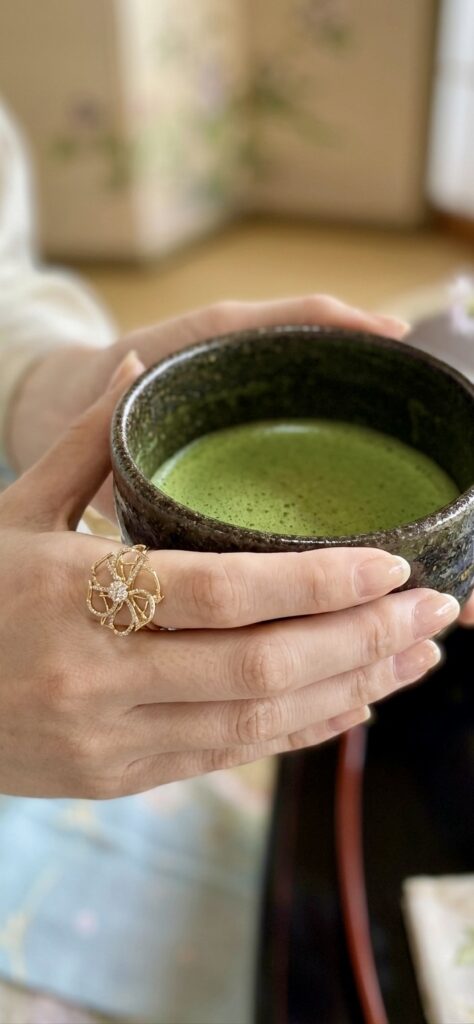
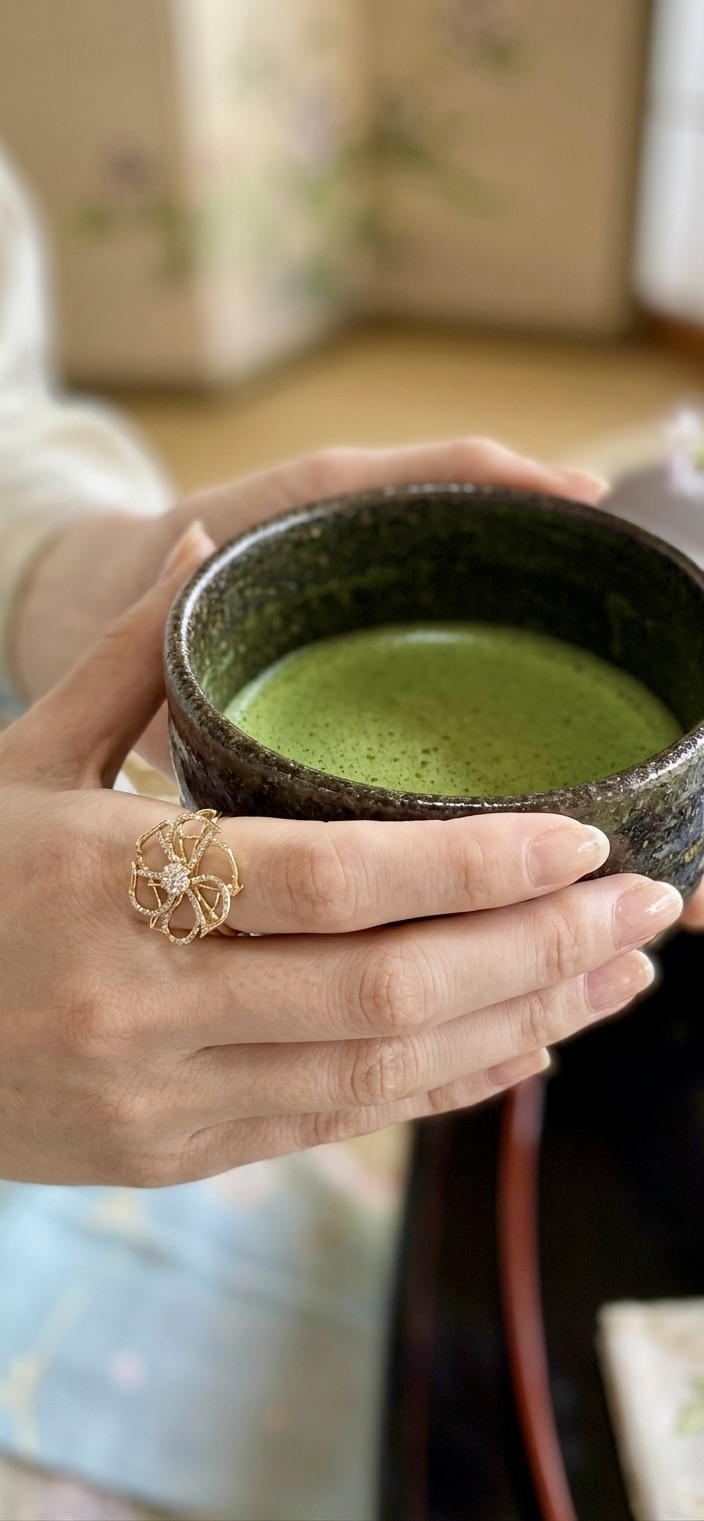
The Japanese phrase ichi-go ichi-e — one time, one meeting — was developed in the context of the tea ceremony. It describes the understanding that each encounter is unique and unrepeatable, and should be treated as such. The bowl in your hands is the only bowl you will hold at this moment.
Good matcha rewards you for paying attention. That is its function. It has always been its function.
Each month, ADAMAS’s Matcha Box delivers ceremonial-grade matcha direct from Uji, Nishio, and Yame — with a hand-thrown chawan and artisan wagashi. Subscribe from $65/month at adamas-gold.jp