Omikuji Japanese Fortune Shrines
On the first three days of January, Japan moves. Nearly 100 million people — roughly 80% of the population — visit a Shinto shrine or Buddhist temple. They pray for the coming year, buy protective amulets, eat ritual foods, and, almost universally, draw a fortune.
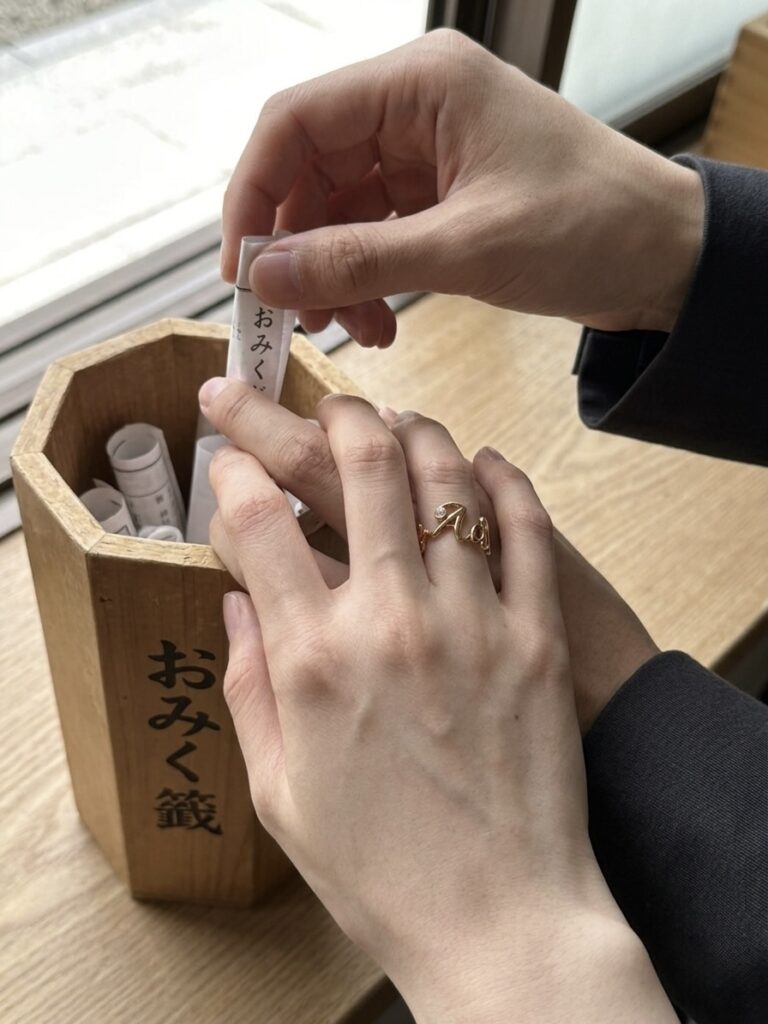
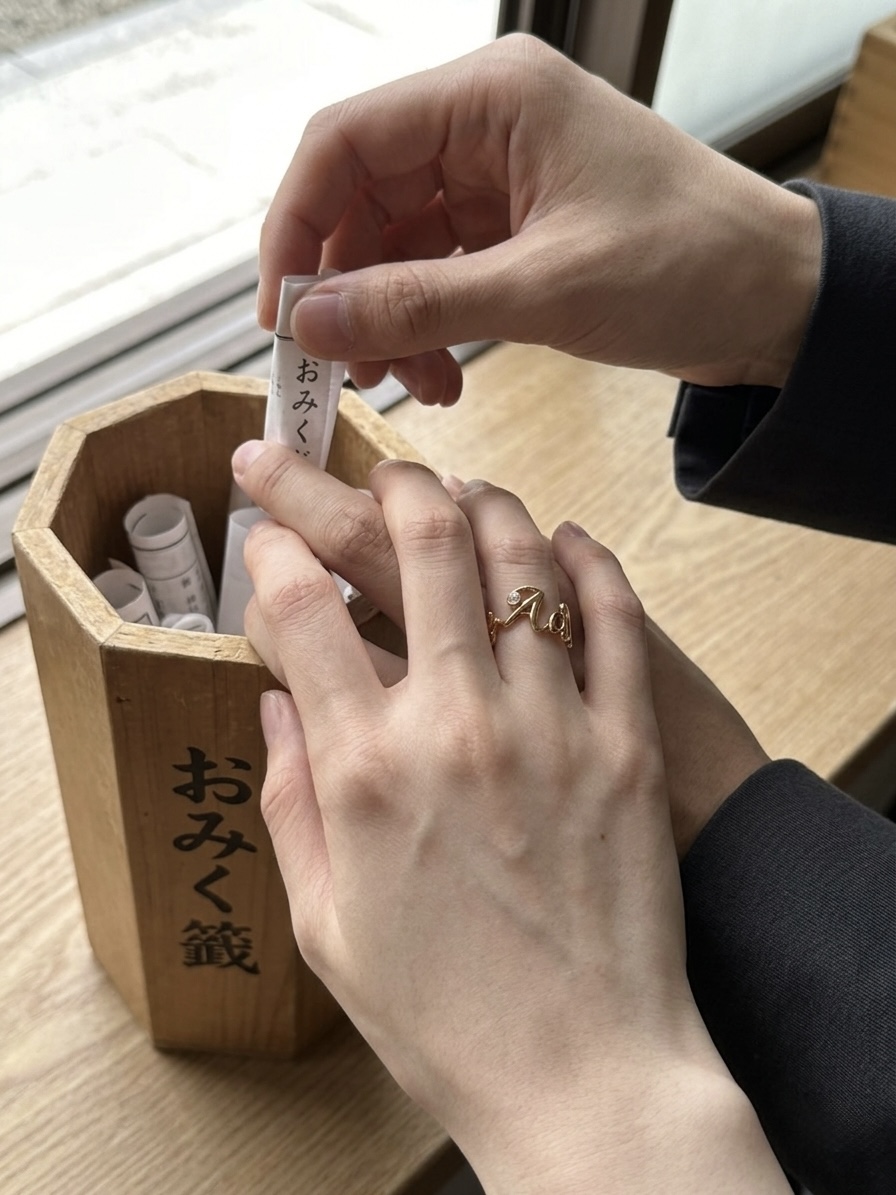
The fortune is an omikuji — a strip of paper printed with a prediction, usually pulled from a wooden box after offering a coin, or drawn from a long bundle of numbered sticks. The predictions range from dai-kichi (great blessing) at the top, through various gradations of good and middling luck, down to kyo (curse) at the bottom.
No one, in the writer’s experience of many January shrine visits, has ever drawn kyo without an immediate, laughing look of theatrical despair. The ritual is designed for exactly this moment.
A Ritual Older Than Japan’s Capital
The practice of seeking divine guidance through random selection predates the written history of Japan. The earliest formal record of what we would recognise as omikuji dates to the late Heian period (around 1000 CE), when the monk Ryogen at Ryoanji Temple in Kyoto used the drawing of numbered sticks to select his successor.
The system was subsequently adopted by shrines throughout Japan, evolving into the printed paper strips that are now so standardised as to be identical across thousands of locations nationwide. Meiji Jingu in Tokyo. Fushimi Inari in Kyoto. Naritasan Shinshoji in Chiba. The box, the coin, the folded paper — they are the same everywhere, and the familiarity is part of the comfort.
The range of gradations varies by shrine, but the most commonly encountered scale runs from dai-kichi (great blessing, ~20%) and kichi (blessing, ~30%) through chu-kichi and sho-kichi to kyo (curse, ~15%). Some shrines include daikyo (great curse); others, perhaps aware of the tourist market, weight their distribution toward good outcomes.
What the Paper Actually Says
The fortune slip is a small document. Beyond the overall result, it typically contains predictions across several life domains: health, study, work, love, and travel. These are written in classical Japanese phrasing — often so archaic that young Japanese people cannot read them without assistance — and tend toward the poetically non-specific.
A typical kichi slip might say, under love: “The one you seek is near, but do not press forward. Be patient, and the meeting will come naturally.” Under travel: “Journeys begun in autumn will prove fortunate. Avoid the north.”
The predictions are not meant to be precise. They are meant to prompt reflection — a quality of attention to the coming year that functions more like a meditation than a prophecy. The serious shrine visitor does not draw omikuji believing that the paper knows their future. They draw it because the act of reading the prediction makes them think, for a few minutes, about what they hope for.
What to Do with a Bad Fortune
If you draw kyo, or any result you find unsatisfactory, you have options.
The traditional response is to tie the paper to a wire rack or a designated tree branch at the shrine — the act of tying it musubu (binding) is a homophone of the word for “to connect,” creating a divine bond. By leaving the bad fortune at the shrine, you leave it in the care of the deity. You walk away lighter.
For obvious reasons, the racks at popular shrines are overwhelmingly full of tied bad fortunes, which tells you something about the psychology of the practice.
Some visitors, drawing a good fortune, also tie theirs — to seal the good luck and strengthen its connection to the divine. Others fold the paper carefully and carry it in their wallet for the year. There is no single correct protocol. The deity, Japanese practitioners suggest, is not particularly rigid about the administration.
Three Shrines Worth Going Out of Your Way For
Fushimi Inari Taisha, Kyoto. Ten thousand vermilion torii gates climbing into the forested hillside. Open 24 hours. The midnight walk through the upper gates, when the tourists have gone, is among the most atmospheric experiences in Japan.
Izumo Taisha, Shimane. Japan’s oldest shrine, dedicated to Okuninushi-no-Mikoto, god of relationships. The scale is extraordinary — the main hall is one of Japan’s largest wooden structures — and the relative remoteness keeps crowds manageable outside peak periods.
Meiji Jingu, Tokyo. For those without time to leave the capital. The forest surrounding the shrine was planted entirely after 1920 from donated trees, and now has the atmosphere of old growth. The New Year crowds exceed three million visitors in the first three days — but on any other day, it is quiet.
Japan’s spiritual culture is one of the world’s most distinctive and least well-explained. ADAMAS JOURNAL covers it from the inside. Discover more at adamas-gold.jp